Imom Buxoriy xalqaro ilmiy-tadqiqot markazi bukhari.uz


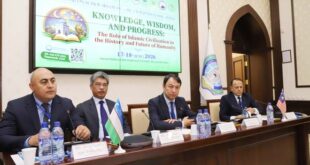
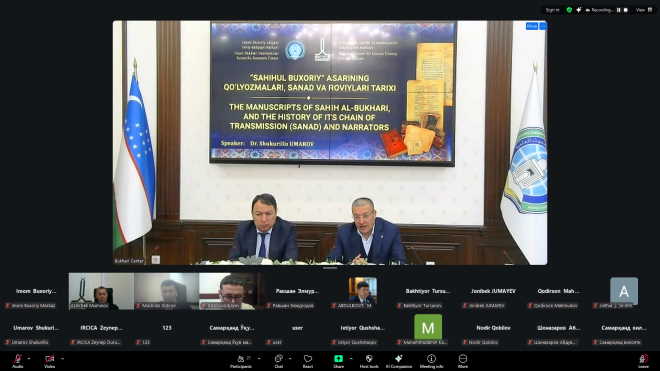
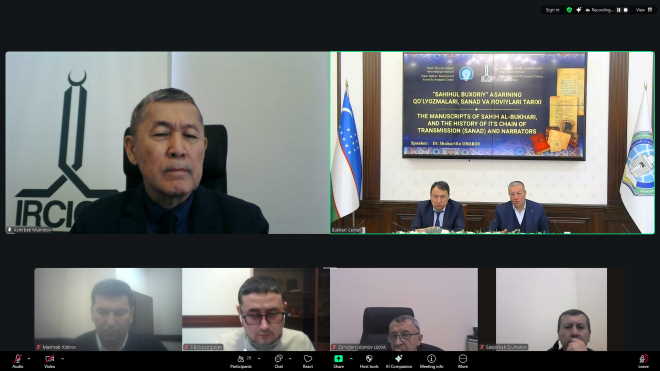
On December 18, the Imom Buxoriy International Scientific Research Center, in collaboration with the Research Centre for Islamic History, Art and Culture (IRCICA), hosted a scheduled online seminar. This event was organized within the framework of the scientific project titled “Central Asia: The Cradle of Islamic Culture and Art.” The seminar featured a distinguished assembly of participants, including: Scientific staff from the Center and representatives of IRCICA; Scholars from the International Islamic Academy of Uzbekistan, the Imom Moturidiy and Imom Termiziy International Scientific Research Centers, and the Institute of Oriental Studies of the Academy of Sciences of Uzbekistan; Faculty members and students from higher education institutions in Samarkand and Bukhara; International researchers from Turkey, Egypt, and Kazakhstan.
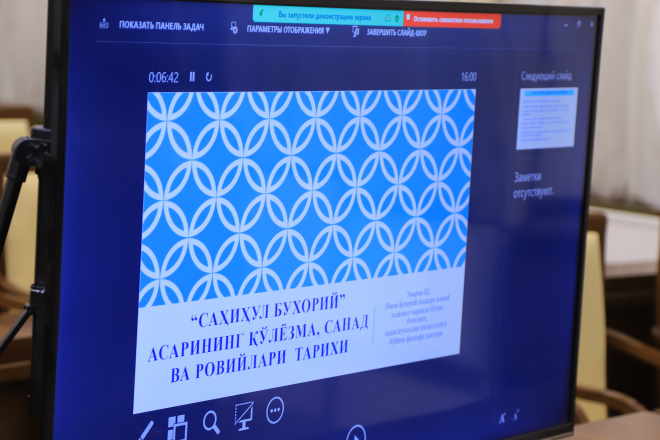
During the seminar, Shukurilla Umarov, a Senior Researcher at the Imam Bukhari International Scientific Research Center and Doctor of Philosophy (PhD) in Historical Sciences, delivered a lecture titled “The History of Manuscripts, Chains of Transmission (Sanad), and Narrators of ‘Sahih al-Bukhari’.
In the history of Islamic civilization, there are certain works that hold incomparable significance—not only as religious texts but also as profound scientific, cultural, and spiritual legacies. Among such unique sources, the most prominent is undoubtedly “Sahih al-Bukhari,” authored by the great scholar of hadith, Imam Bukhari. The presenter provided a comprehensive analysis of the work’s transmission paths, its narrators, and various manuscript copies, while also offering scholarly refutations to doubts and criticisms raised against the text.
One of the key issues emphasized in the lecture was the mechanism by which “Sahih al-Bukhari” has been preserved and transmitted to us in its authentic form. It was noted that for over 400 years following Imam al-Bukhari’s passing, the work was narrated through continuous and reliable chains of transmission (sanad). The lecture particularly highlighted the invaluable contributions of scholars from Mawarannahr in this process, specifically citing the pivotal roles played by such figures as Muhammad ibn Yusuf al-Firabri and Ibrahim ibn Ma’qal al-Nasafi.
The lecture also presented significant scientific data regarding the geographic distribution and total number of manuscript copies of “Sahih al-Bukhari.” According to sources, more than 8,000 copies of the work are currently preserved in over 2,300 manuscript repositories worldwide. These are housed in major libraries in countries such as Turkey, Egypt, Germany, Bulgaria, Qatar, the United States, and Uzbekistan. Certain manuscripts are of particular scientific and historical significance, as they were transcribed a mere 5 to 10 years after the passing of Imam Bukhari.
During the lecture, critical perspectives regarding “Sahih al-Bukhari” were subjected to scholarly analysis. Reliable scientific evidence was presented to counter the claims of certain modern critics who raise doubts concerning the work’s original manuscript. The speaker drew a comparative parallel, noting that the Holy Qur’an has been preserved through the exact same mechanisms of sanad (chains of transmission), hifz (memorization), and ummat ittifoqi (the consensus of the community). He emphasized that such skepticism toward the science of Hadith is, in fact, intended to undermine the authority of Islamic foundational sources.
The lecture presented a comprehensive justification that the work ‘Sahih al-Bukhari’ reached us not by chance or through legendary narratives, but rather through precise scientific criteria, robust chains of transmission (sanads), a profound sense of responsibility, and the continuous labor of scholars over centuries. This reinforces its standing not only as a religious pillar but also as a significant achievement within the global scientific and intellectual heritage.
The seminar concluded with a vibrant exchange of ideas and an engaging question-and-answer session.
Imam Bukhari International scientific Research Center
Press Service