Imom Buxoriy xalqaro ilmiy-tadqiqot markazi bukhari.uz



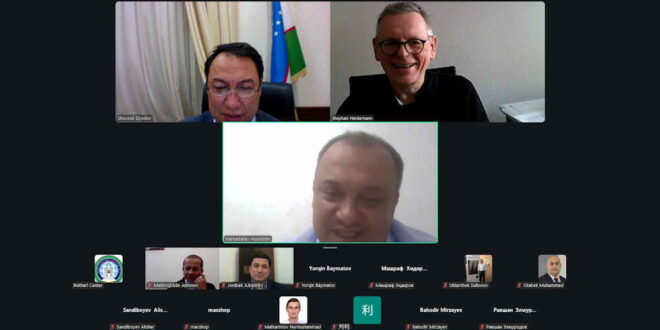
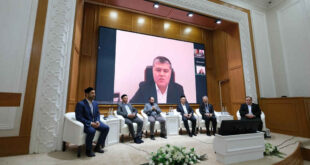
The Imam Bukhari International Scientific Research Center, in cooperation with the Institute of Asian and African Studies at the University of Hamburg, Germany, held another online seminar as part of the lecture series “Cultural Heritage of the Zarafshan Valley.”
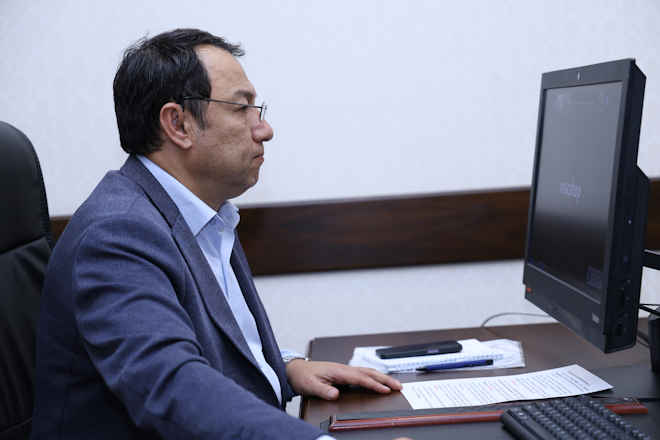
The seminar brought together researchers from the Center, scholars from the Institute of Oriental Studies of the Academy of Sciences of Uzbekistan and the Samarkand Institute of Archaeology named after Yahyo Ghulomov, researchers from the Imam Termizi International Scientific Research Center, participants from the Samarkand Branch of the Institute for Advanced Training and Retraining in the Religious and Educational Sphere under the Committee on Religious Affairs, as well as teachers and students of the Mir Arab Secondary Specialized Islamic Educational Institution.
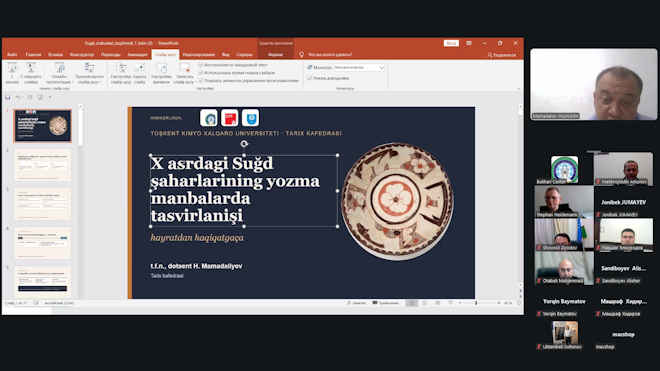
The seminar featured a lecture by historian Khusniddin Mamadaliev, Associate Professor at Kimyo International University in Tashkent, entitled “Description of the Cities of Sogd in the 10th Century in Islamic Written Sources: From Wonder to Reality.”
In his presentation, the scholar examined how ancient cities such as Samarkand and Bukhara were described in the writings of tenth-century Muslim geographers, focusing on their historical appearance, economic life, and urban planning traditions. Particular attention was given to geographical works by al-Istakhri, Ibn Hawqal, and al-Muqaddasi, as well as accounts found in Narshakhi’s history of Bukhara.
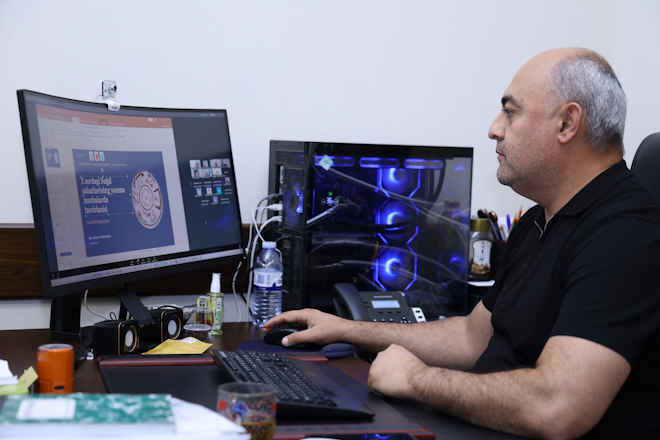
The speaker noted that medieval geographical sources often portrayed cities through vivid literary descriptions and occasional exaggeration. Nevertheless, these accounts also contain substantial factual information reflecting historical realities. A key aspect of the research, therefore, is to identify the historical evidence underlying such descriptions, conduct comparative analyses of written sources, and examine their findings alongside other historical evidence.
During the lecture, valuable information was presented on the urban layouts of Samarkand and Bukhara, their defensive walls and gates, irrigation and drainage systems, markets, trade routes, handicraft production, and waqf properties. Special attention was devoted to descriptions of Samarkand’s prosperity, gardens, water infrastructure, and architectural landscape.
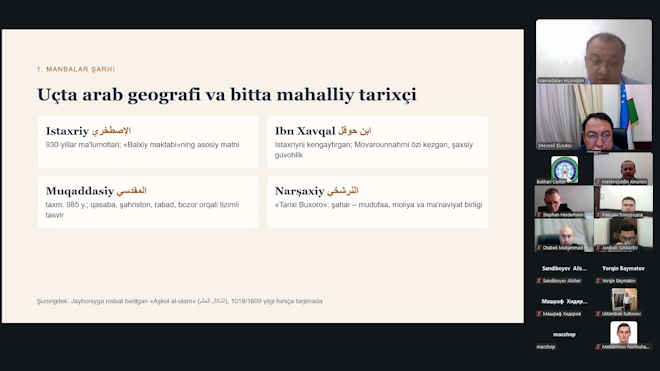
The speaker also emphasized that while medieval geographical writings provide extensive accounts of the material and economic life of cities, other categories of historical sources, including biographical dictionaries, works on the scholarly classes (tabaqat), and Islamic jurisprudential texts, are equally important for reconstructing their intellectual and scholarly environments.

The seminar concluded with an exchange of views on the importance of comparing historical sources, supplementing written accounts with archaeological evidence, and exploring opportunities to further strengthen cooperation between the Center and international academic institutions.
Press Service