Imom Buxoriy xalqaro ilmiy-tadqiqot markazi bukhari.uz



The renowned writer Chingiz Aitmatov warns that wherever moral collapse, erosion, and ethical corruption occur in our spiritual environment, an invisible wave of evil and fear spreads from that corrupted environment throughout the world, and global justice is disrupted[1]. Indeed, a human being can only step toward eternity through one path – the path of moral improvement from generation to generation – and only by uniting all of humanity and eliminating disasters and vices can the future of life be renewed[2]. “In accordance with the truth that “any reform begins with changing the human being,” raising a perfect individual and elevating human dignity, worth, life, rights, and freedom to the level of the highest value has become an extraordinary necessity in today’s complex and contradictory era of globalization.
The general ruling for Muslims is to live among people, maintain social relations with the people of the world, and fulfill their rights[3]. In particular, parents, siblings, and close relatives have certain rights. Especially, the role of parents in the upbringing of an individual is immeasurably great. In Islam and our national values, it is acknowledged that parents hold many rights over their children, and fulfilling those rights is considered obligatory. It is repeatedly emphasized that any disrespect shown by a child toward their parents is a grave sin that cannot be justified by anything.
In the Holy Quran it is stated: “Your Lord has decreed that you worship none but Him, and that you be kind to parents. Whether one or both of them attain old age in your life, say not to them a word of contempt, nor repel them, but address them in terms of honor” (Surah Al-Isra, verse 23).
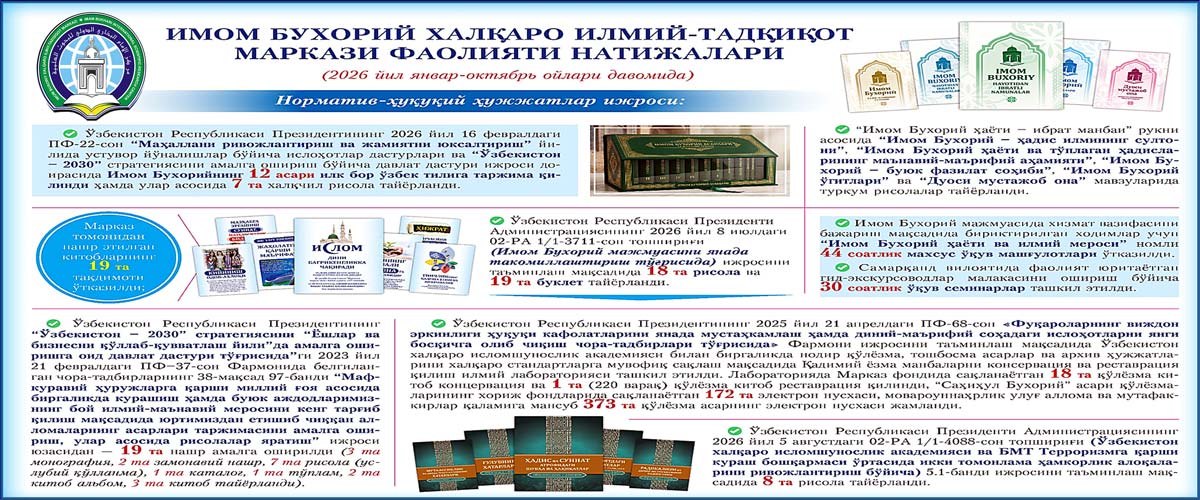
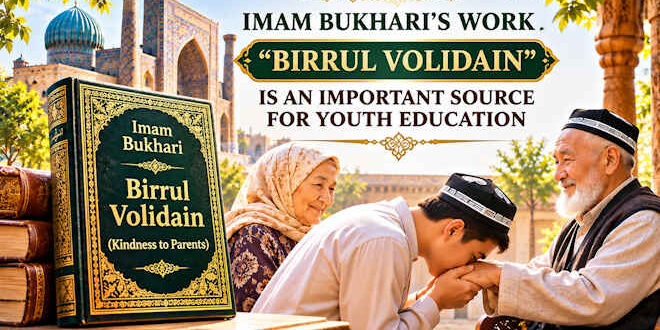
Numerous hadiths also testify that among all people, parents are the most deserving of kind treatment. Since this is an extremely important matter, the great muhaddith Imam Bukhari compiled the authentic hadiths concerning kindness to parents and wrote the work “Birrul Walidayn” (“Kindness to Parents”).
In a hadith narrated by Abdullah ibn Mas’ud (may Allah be pleased with him), cited in this work: “I asked the Prophet (peace be upon him): ‘Which deed is best?’ He said: “Prayer, kindness to parents, and striving in the way of Allah” [4]. A person is indebted for the human qualities within himself first to the Creator who brought him into existence from nothing, then to his parents, and then to people and society[5]. The hadith states that kindness to parents is the most obligatory deed after prayer.
It is narrated from Abu Hurairah (may Allah be pleased with him): “A man came to the Prophet (peace be upon him) and asked: “O Messenger of Allah! Who is most deserving of my kind treatment? He said: Your mother. Then who? Your mother.Then who? Your mother. Then who?Then your father”[6]. This hadith states that a mother’s right over her child is three times greater than a father’s. This is not without reason – the hadith takes into account all the hardships a mother endures: carrying the child for nine months and all the difficulties related to raising the child afterward.
It is narrated from Abdullah ibn Amr (may Allah be pleased with him): “A man left his parents crying and came to the Prophet (peace be upon him) to pledge allegiance. The Prophet said: ‘Go back to your parents and make them laugh just as you made them cry”[7] This hadith forbids any action that would grieve one’s parents and commands behavior that brings them joy.
One of the noble ideas promoted in the works of the great poet and thinker Alisher Navoi (1441-1501) is showing respect to humanity, and first and foremost, to one’s parents.In his work “Nasayim ul-Muhabbat”, it is described as follows: “Ismail Dabbos said: “Having made the intention to perform Hajj, I reached Shiraz on my way. I entered a mosque and saw Sheikh Mo’min sitting and mending his cloak. I greeted him and sat down. He asked me: What is your intention? I said: I intend to perform Hajj. He said: Do you have a mother? I said: Yes. He said: Go back and attend to your mother… I have performed fifty Hajj pilgrimages — bareheaded, barefooted, without provisions or companion. I give all of them to you; you give me the joy of your mother’s heart!”[8]. This is a lofty example of honoring one’s parents in Navoi’s interpretation, and an important aspect of the perfect human concept promoted by the great poet:
Sacrifice your head before your father,
Give your body as an offering for your mother.
If you desire prosperity in both worlds,
Earn their satisfaction, both of them.
To illuminate your days and nights,
Consider one of them the moon, the other the sun[9].
It is narrated from Anas ibn Malik (may Allah be pleased with him): “Our Prophet (peace be upon him) said: “Whoever wishes for his life to be long and his provision to be increased, let him be kind to his parents”[10]. The hadith calls upon one to treat parents well and earn their approval as a guarantee of longevity and abundance of provision.
It is narrated from Abu Hurairah (may Allah be pleased with him): “The Messenger of Allah (peace be upon him) said: “There are three supplications that are undoubtedly answered: the supplication of the oppressed, the supplication of the traveler, and the supplication of a parent for their child”[11]. From this, it becomes clear that fulfilling the rights of the oppressed, the traveler, and one’s parents and receiving their prayers is a source of goodness and blessing — while doing the opposite is a source of misguidance.
In conclusion, the lofty moral virtues promoted in the sacred sources of Islam and the scholarly-spiritual heritage of our great ancestors serve the purpose of raising a perfect human being.
- Aytmatov Ç. Kassandra tamğasi. –T.: Yangi asr avlodi, 2016.
- Sahihi Buxoriy şarhi. 3 jildlik. Ikkinçi jild. – T.: Hilol-Naşr, 2022.
- Imom Buxoriy. Birrul volidayn (Ota-onaga yaxşilik qiliş). – Samarqand, IBXITM, 2024.
- Ğaybulloh as-Salom. Asarlar. 1-Kitob. Ey, umri aziz. –T.: Şarq, 1996.
- Alişer Navoiy. Nasoyim-ul muhabbat // Mukammal asarlar töplami. 20 tomlik. 17 tom. – T.: Fan, 2001. –B. 219.
- Alişer Navoiy. Hayratul abror // Mukammal asarlar töplami. 20 tomlik. 7 tom. – T.: Fan, 2001
Senior Research Fellow,
Doctor of Philosophy