Imom Buxoriy xalqaro ilmiy-tadqiqot markazi bukhari.uz




Introduction
The question of good governance has become one of the most important issues in contemporary political discourse. Across many societies, governance crises such as corruption, abuse of power, weak accountability, and declining public trust in political institutions have generated growing concern regarding the ethical foundations of political authority. In many Muslim societies, these concerns have encouraged scholars to revisit classical Islamic intellectual traditions in search of governance models rooted in moral responsibility, justice, and human welfare.
Within the Islamic worldview, governance is not merely a political mechanism for maintaining social order; rather, it is fundamentally an ethical responsibility. The Qur’ān repeatedly emphasizes justice, trust, accountability, and consultation as essential principles of political authority. Allah says:
“Indeed, Allah commands you to render trusts to whom they are due and when you judge between people to judge with justice.”[1]
Similarly, the Qur’ān praises those:
“who conduct their affairs by mutual consultation.”[2]
These verses demonstrate that Islamic governance is inseparable from ethical accountability and social justice. Leadership in Islam is understood as a trust (amānah) that requires moral integrity, fairness, and responsibility toward society.
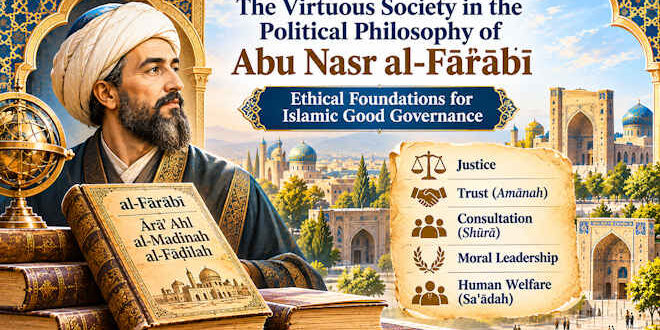
Among the major Muslim philosophers who developed a systematic theory of ethical governance was Abu Nasr al-Farabi (c. 872–950 CE), often referred to as “the Second Teacher” (al-Muʿallim al-Thānī) after Aristotle. al-Fārābī’s political philosophy represents a sophisticated synthesis of Greek philosophical traditions and Islamic ethical teachings. His most influential political work, Ārāʾ Ahl al-Madīnah al-Fāḍilah (Opinions of the People of the Virtuous City), presents a comprehensive model of an ideal society governed by virtuous leadership and guided by intellectual wisdom.
According to al-Fārābī, the ultimate purpose of political authority is not merely the preservation of order or material prosperity but the guidance of human beings toward saʿādah (true happiness), which he understood as the highest form of moral and intellectual perfection. The virtuous society therefore depends upon leaders who possess wisdom, moral virtue, and the ability to guide citizens toward ethical excellence.
Although al-Fārābī developed his philosophy during the classical Islamic period, many of the ethical concerns addressed in his writings remain highly relevant today. Modern political systems often prioritize economic performance, political competition, and institutional efficiency while neglecting ethical leadership and moral responsibility. As a result, contemporary societies continue to struggle with corruption, injustice, and social fragmentation.
This paper explores al-Fārābī’s concept of the virtuous society and examines its relevance for contemporary Islamic good governance. By analysing the ethical foundations of his political philosophy and relating them to Qur’ānic principles of governance, the study seeks to demonstrate that al-Fārābī’s thought remains a valuable intellectual resource for addressing modern governance challenges.
Intellectual and Historical Context of al-Fārābī
Understanding al-Fārābī’s political philosophy requires examining the intellectual environment in which he lived. al-Fārābī emerged during the Abbasid era, a period widely recognized as the intellectual golden age of Islamic civilization. This era witnessed major advancements in philosophy, science, medicine, mathematics, and theology.
Abu Nasr al-Fārābī was born in Farab in Transoxiana (present-day Kazakhstan). He later travelled to Baghdad, which had become the leading centre of philosophical and scientific scholarship in the Islamic world. Baghdad hosted scholars from diverse intellectual backgrounds who were engaged in the translation and interpretation of Greek philosophical texts.[3]
One of the most significant intellectual developments of the Abbasid period was the Graeco-Arabic translation movement. Greek works by Plato, Aristotle, and other philosophers were translated into Arabic through institutions such as Bayt al-Ḥikmah (House of Wisdom). This movement enabled Muslim scholars to engage deeply with Greek philosophy while integrating it into Islamic intellectual traditions.[4]
al-Fārābī was particularly influenced by Plato and Aristotle. Plato’s Republic shaped his understanding of the ideal political community and the role of the philosopher-ruler, while Aristotle’s ethical and political theories influenced his conception of human flourishing and social organization.[5]
However, al-Fārābī did not merely imitate Greek philosophy. Instead, he reformulated philosophical concepts within an Islamic ethical framework. His political philosophy reflects an attempt to harmonize rational inquiry with moral and spiritual values rooted in Islamic civilization.
The intellectual culture of Central Asia also contributed significantly to his development. Cities such as Bukhara and Samarkand had become major centers of learning that produced influential scholars in philosophy, theology, jurisprudence, and hadith studies.[6] This scholarly environment encouraged interdisciplinary learning and philosophical reflection.
Because of his mastery of logic and philosophy, al-Fārābī was honoured with the title “the Second Teacher,” acknowledging his position as the most important philosopher after Aristotle within the Islamic philosophical tradition.[7]
The Concept of the Virtuous Society (al-Madīnah al-Fāḍilah)
The concept of al-Madīnah al-Fāḍilah represents the central element of al-Fārābī’s political philosophy. In this model, society exists not merely to ensure security or economic prosperity but to guide individuals toward the attainment of true happiness (saʿādah).
al-Fārābī begins by emphasizing that human beings are naturally social creatures who cannot achieve perfection independently. He writes:
“Human beings cannot attain the perfection for which their natural disposition was created except through association with many people who cooperate with one another, each providing something necessary for the life of others”.[8]
This statement establishes a fundamental principle of al-Fārābī’s political thought: human perfection can only be achieved within a cooperative social order.
The ultimate goal of the virtuous society is the attainment of true happiness. al-Fārābī defines the virtuous city as:
“The virtuous city is the city in which people cooperate in attaining the things through which true happiness is achieved”.[9]
Unlike societies driven primarily by wealth, political power, or material pleasures, the virtuous society directs all institutions toward moral and intellectual excellence.
al-Fārābī compares society to the human body. Just as different organs cooperate to sustain life, different social groups cooperate to sustain the political community. Each group contributes according to its abilities:
- leaders provide intellectual and moral guidance,
- scholars cultivate knowledge,
- administrators maintain political order,
- artisans and workers contribute to economic prosperity.
Social harmony emerges when everyone performs the role best suited to their abilities.[10]
At the centre of this society stands the virtuous ruler. al-Fārābī states:
“The first ruler must be the most perfect of human beings in humanity, the most complete in virtue, and the most excellent in intellect”.[11]
The ruler must therefore combine intellectual wisdom, moral virtue, and practical leadership ability. This concept resembles Plato’s philosopher-king but is reformulated within an Islamic ethical framework in which leadership is understood as a moral trust.
al-Fārābī also contrasts the virtuous society with corrupt and ignorant societies. He writes:
“The ignorant city is the city whose people do not know true happiness”.[12]
Such societies prioritize wealth, pleasure, and political domination rather than moral and intellectual development. As a result, they fail to achieve genuine human flourishing.
This distinction remains highly relevant in modern political analysis, where many societies prioritize material success while neglecting ethical responsibility and social justice.
Ethical Leadership in al-Fārābī’s Political Philosophy
Ethical leadership occupies a central position in al-Fārābī’s theory of governance. For al-Fārābī, the success or failure of society depends primarily on the moral and intellectual qualities of its leadership.
Leadership is not merely an administrative function; rather, it is an ethical responsibility aimed at guiding society toward justice and happiness. The ruler must possess wisdom, moral integrity, courage, and knowledge of truth.
This conception strongly resonates with Islamic teachings on governance. In Islam, political authority is regarded as a trust (amānah). Allah says:
“Indeed, We offered the trust to the heavens and the earth and the mountains, but they declined to bear it… yet man undertook it.” (Qur’ān 33:72)
Leadership therefore carries profound moral responsibilities.
The Prophet Muḥammad PBUH also emphasized accountability in leadership:
“Each of you is a shepherd and each of you is responsible for his flock.”[13]
This hadith establishes accountability as a fundamental principle of governance.
al-Fārābī’s understanding of ethical leadership also corresponds closely with the Qur’ānic concept of justice (ʿadl). Allah commands:
“Indeed, Allah commands justice, excellence, and giving to relatives, and forbids immorality, wrongdoing, and oppression.” (Qur’ān 16:90)
In the virtuous society, justice is not merely a legal mechanism but a moral principle guiding the entire political order. A virtuous ruler ensures that institutions function harmoniously and that citizens contribute to the collective welfare of society.
Modern governance theories similarly emphasize ethical leadership, transparency, and accountability. Contemporary political crises often emerge when leaders prioritize personal interests over public welfare. al-Fārābī’s philosophy therefore provides an important corrective by emphasizing that leadership must be rooted in virtue rather than power alone.
Consultation, Knowledge, and Moral Education
Another important principle in al-Fārābī’s political philosophy is the relationship between governance and collective cooperation. Although he emphasizes the importance of virtuous leadership, he also recognizes the need for cooperation among different members of society.
This principle parallels the Islamic concept of shūrā (consultation). The Qur’ān praises believers as those:
“who conduct their affairs by mutual consultation.”[14]
Consultative governance prevents the concentration of power and encourages collective participation in decision-making.
al-Fārābī further emphasizes the importance of knowledge in governance. Political authority must be guided by wisdom and intellectual competence. Leaders must possess deep understanding of justice, ethics, and social welfare in order to govern effectively.
This emphasis remains highly relevant today. Contemporary governance increasingly depends on evidence-based policymaking and informed leadership capable of addressing complex social and economic challenges.
Equally important is al-Fārābī’s emphasis on moral education. He states:
“The community must be taught the virtues so that all their actions become virtuous”.[15]
Political institutions alone cannot sustain ethical governance unless citizens themselves possess moral awareness and civic responsibility.
The Prophet PBUH emphasized the importance of moral character when he said:
“I was only sent to perfect noble character.”[16]
This hadith highlights the central role of ethics in Islamic civilization.
Modern societies increasingly recognize the importance of civic education in promoting responsible citizenship and social cohesion. al-Fārābī’s philosophy therefore anticipates contemporary discussions concerning ethical education and civic responsibility.
Relevance to Contemporary Islamic Good Governance
al-Fārābī’s concept of the virtuous society remains highly relevant for contemporary Muslim societies facing governance challenges such as corruption, weak accountability, political instability, and declining public trust.
Islamic good governance refers to a system of governance guided by ethical principles derived from the Qur’ān, Sunnah, and Islamic intellectual traditions. These principles include:
- justice (ʿadl),
- trust (amānah),
- consultation (shūrā),
- accountability,
- and public welfare (maṣlaḥah).
al-Fārābī’s philosophy aligns closely with these principles.
First, his emphasis on ethical leadership highlights the need for leaders who possess integrity, wisdom, and commitment to public welfare. Many governance failures today stem from the absence of moral accountability among political elites.
Second, al-Fārābī’s focus on justice provides an important framework for addressing social inequality and political oppression. Governance systems must prioritize fairness and protection of human dignity.
Third, his emphasis on knowledge-based leadership remains essential in an era where policymaking requires intellectual competence and ethical judgment.
Fourth, his stress on moral education demonstrates that governance reform cannot succeed without cultivating ethically responsible citizens.
al-Fārābī’s philosophy also corresponds with the objectives of Sharīʿah (maqāṣid al-sharīʿah), which seek to protect religion, life, intellect, property, and human dignity. His vision of governance ultimately aims at promoting comprehensive human flourishing and social harmony.
Contemporary Muslim societies can therefore benefit from revisiting al-Fārābī’s intellectual heritage in developing governance models rooted in both ethical responsibility and institutional effectiveness.
Policy Implications
al-Fārābī’s political philosophy offers several practical insights for contemporary governance reform:
- Strengthening Ethical Leadership
Governance institutions should prioritize leaders who demonstrate moral integrity, competence, and commitment to public welfare. Leadership training programs should emphasize ethical responsibility and accountability.
- Promoting Transparency and Accountability
Anti-corruption measures, independent oversight institutions, and transparent governance mechanisms are essential for strengthening public trust.
- Integrating Moral Education
Educational institutions should incorporate ethical and civic education that cultivates responsibility, justice, and social awareness.
- Encouraging Consultative Governance
Inclusive decision-making processes involving scholars, experts, and community representatives can improve governance legitimacy and effectiveness.
- Aligning Governance with Maqāṣid al-Sharīʿah
Public policies should prioritize human welfare, social justice, and protection of human dignity in accordance with the objectives of Sharīʿah.
Conclusion
Abu Nasr al-Fārābī’s concept of al-Madīnah al-Fāḍilah represents one of the most significant contributions to Islamic political philosophy. His vision of governance is grounded in ethical leadership, intellectual wisdom, justice, consultation, and moral education.
al-Fārābī understood political authority not as a means of domination but as a moral responsibility aimed at guiding society toward true happiness and human flourishing. By integrating philosophical reasoning with Islamic ethical principles, he developed a sophisticated model of governance that continues to offer valuable insights for contemporary Muslim societies.
In the modern world, where governance crises frequently stem from corruption, injustice, and ethical decline, revisiting al-Fārābī’s political philosophy provides an opportunity to recover a rich intellectual tradition centred on moral responsibility and public welfare.
Ultimately, al-Fārābī’s virtuous society reminds contemporary societies that sustainable governance cannot be achieved through institutions alone. Rather, it requires virtuous leaders, morally conscious citizens, and a political culture grounded in justice, wisdom, and ethical accountability.