Imom Buxoriy xalqaro ilmiy-tadqiqot markazi bukhari.uz





Introduction
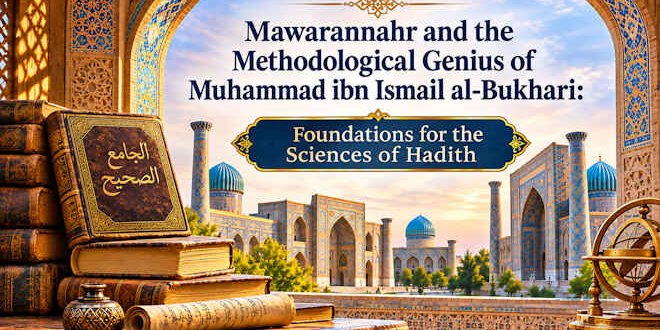
Mawarannahr, occupied a central position in the intellectual history of Islamic civilisation. The region, which included important cities such as Bukhara, Samarqand, and Tirmidh, became a flourishing centre of scholarship during the classical Islamic period. It produced distinguished scholars in various disciplines, including Hadith, fiqh, kalām, tafsīr, and philosophy.
Among the greatest scholars produced by this region was Imām Muhammad ibn Ismail al-Bukhārī (194–256 AH), whose contribution to the sciences of Hadith remains unparalleled. His work, al-Jāmiʿ al–Ṣaḥīḥ, is universally recognised by Sunni scholars as the most authentic book after the Qurʾān. More importantly, his contribution extends beyond compilation; he established a highly systematic and rigorous methodology that transformed the study of Hadith into a disciplined scientific field.
This paper explores the methodological genius of al-Bukhari within the intellectual environment of Mawarannahr and examines how his scholarly approach laid foundational principles for the sciences of Hadith.
Mawarannahr as a Centre of Islamic Scholarship
Mawarannahr emerged as one of the leading centres of Islamic learning during the early centuries of Islam. The region was characterised by strong scholarly networks, intellectual exchange, and a culture of riḥlah fī ṭalab al-Hadith (travelling in search of Hadith). Scholars from this region travelled extensively across the Islamic world, while students from distant lands journeyed to Mawarannahr to study under its leading scholars.
The scholarly culture of Mawarannahr emphasised memorisation, precision, critical analysis, and rigorous academic engagement. This intellectual environment contributed significantly to the development of major scholars such as Imam al-Bukhārī, Imam al-Tirmidhī and Imam al-Dārimī. The region, therefore, played a crucial role in shaping both religious sciences and the broader intellectual heritage of Islamic civilisation.
Imam al-Bukhari: His Life and Scholarly Formation
Muhammad ibn Ismail al-Bukhārī was born in Bukhara in 194 AH. From a young age, he displayed extraordinary intellectual abilities and exceptional memory. Historical reports mention that he memorised thousands of Hadith during his early years.
al-Bukhārī travelled extensively throughout the Islamic world in pursuit of knowledge, visiting Makkah, Madinah, Iraq, Syria, Egypt, Khurasan, and other centres of learning. He studied under more than one thousand scholars and developed profound expertise in the sciences of Hadith.
His most celebrated work is al-Jāmiʿ al–Ṣaḥīḥ, which he compiled over a period of approximately sixteen years. The work contains approximately 7,563 narrations, with repetitions, and represents one of the greatest scholarly achievements in Islamic intellectual history.
The Methodological Genius of al-Bukhari
The greatness of al-Bukhari lies not merely in his collection of Hadith but in his scientific methodology. His methodological genius can be observed through several dimensions.
Criteria of Authenticity
al-Bukhari established highly rigorous criteria for accepting narrations. These conditions include:
- Continuity of the chain of transmission (ittiṣāl al-sanad).
- Integrity and uprightness of narrators (ʿadālah).
- Precision and accuracy in memorisation and transmission (ḍabṭ).
- Absence of hidden defects and contradictions.
- Verification that narrators had met each other (liqāʾ).
This final condition became one of the distinguishing features of al-Bukhari’s methodology and contributed significantly to the reliability of his collection.
Analytical Evaluation of Narrators
al-Bukhari demonstrated remarkable expertise in al-jarḥ wa al-taʿdīl, the critical evaluation of narrators. He compared different chains of transmission and exercised independent scholarly judgement rather than relying solely on earlier authorities. His analytical precision enabled him to identify subtle differences between narrations and determine their reliability.
Method of ʿIlal
One of the most sophisticated aspects of al-Bukhari’s scholarship was his mastery in detecting hidden defects (ʿilal) in narrations. This required deep familiarity with transmission patterns, narrator biographies, and textual variations. His contemporaries widely recognised his expertise in this field.
Fiqh al-Bukhari
al-Bukhari’s juristic understanding is reflected in the chapter headings (tarājim al-abwāb) of al-Jāmiʿ al–Ṣaḥīḥ. Through subtle structuring and careful placement of narrations, he derived legal rulings and theological insights. This gave rise to the famous scholarly statement: “Fiqh al-Bukhārī fī tarājimih” (The fiqh of al-Bukhari lies in his chapter headings).
Mawarannahr’s Influence on al-Bukhari’s Methodology
The intellectual environment of Mawarannahr played a major role in shaping al-Bukhari’s scholarly methodology. The region’s emphasis on precision, memorisation, and critical scholarship provided the foundation for his methodological rigour.
The strong culture of scholarly debate and intellectual competition also contributed to the refinement of his methods. Exposure to diverse scholars and traditions enabled al-Bukhari to cultivate an analytical approach that combined rigorous authentication with systematic organisation.
His methodology, therefore, reflects not only his personal genius but also the excellence of the scholarly tradition of Mawarannahr.
Contribution to the Sciences of Hadith and Islamic Civilisation
al-Bukhari’s methodology transformed the sciences of Hadith into a highly structured and disciplined field of study. By establishing rigorous standards for authenticity and classification, he elevated Hadith studies from mere transmission to a scientific discipline.
His methodology influenced later scholars, including Imām Muslim, al-Tirmidhi, and many others who adopted and expanded his principles. al-Jāmiʿ al–Ṣaḥīḥ became a foundational reference for Islamic scholarship and exerted profound influence on fiqh, theology, ethics, and broader Islamic intellectual thought.
Moreover, his contribution played a vital role in preserving the Sunnah of the Prophet Muhammad PBUH and safeguarding the authenticity of Islamic teachings for later generations.
Conclusion
Mawarannahr served as a fertile intellectual environment for the development of Islamic scholarship, particularly in the sciences of Hadith. Within this distinguished scholarly tradition emerged Imam Muhammad ibn Ismail al-Bukhari, whose methodological genius established foundational principles for the sciences of Hadith.
Through his rigorous criteria of authenticity, analytical evaluation of narrators, mastery of hidden defects, and sophisticated structuring of knowledge, al-Bukhari transformed the study of Hadith into a scientific discipline. His legacy continues to shape Islamic scholarship and remains one of the greatest intellectual contributions of Mawarannahr to Islamic civilisation.