Imom Buxoriy xalqaro ilmiy-tadqiqot markazi bukhari.uz




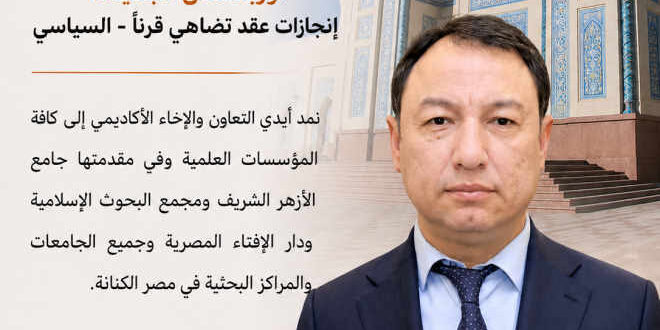
An analytical article entitled “Religious and Educational Reforms in Uzbekistan” by Shovosil Ziyodov, Director of the Imam Bukhari International Scientific Research Center and Doctor of Historical Sciences, Professor, has been published by As-Siyasi, a prominent Egyptian electronic publication.
In recent years, researchers at the Imam Bukhari International Scientific Research Center have increasingly contributed articles to international publications highlighting Uzbekistan’s religious and educational reforms, as well as the country’s efforts to study and preserve the rich intellectual legacy of its great scholars. The growing number of such publications reflects the increasing international interest in Uzbekistan’s history and culture and in the outcomes of the reforms being implemented across the country.
In his article, Shovosil Ziyodov emphasizes that, within the broad programme of renewal and strategic reforms carried out in New Uzbekistan under the leadership of President Shavkat Mirziyoyev, religious education, the restoration of national and spiritual values, and their further development have assumed a particularly important place.
The author argues that the principle put forward by the President – “Enlightenment against ignorance” – has evolved into an effective model for addressing radicalism and fanaticism. Rather than relying primarily on administrative or coercive measures, this approach seeks to strengthen society through knowledge and education, while promoting a deeper study of the rich intellectual and spiritual heritage of previous generations.
The article also provides a detailed overview of the work carried out by key institutions that form the institutional foundation of this sphere, including the Islamic Civilization Center in Uzbekistan, as well as the Imam Bukhari, Imam Maturidi and Imam Termizi International Scientific Research Centers. These institutions are engaged in studying the intellectual heritage of Muslim scholars and preparing scholarly responses to distorted and extremist interpretations.
The establishment of the prestigious “Imam Bukhari” Order is also highlighted. The article notes that the high state distinction has been awarded to leaders of foreign countries as well as prominent religious scholars of Uzbekistan in recognition of their contributions.
In addition, the article examines the activities of the International Islamic Academy of Uzbekistan, the Higher School for Hadith Sciences and the Tashkent Islamic Institute. Particular attention is given to initiatives such as issuing scholarly ijazahs (certifications of authorization in the transmission and teaching of Islamic scholarly traditions), training specialists in 3D modelling and Islamic finance, and establishing mechanisms to support and encourage young scholars.
The article further emphasizes that human dignity and the principle of humanism lie at the heart of the ongoing reforms.
In this regard, the author highlights a number of significant humanitarian initiatives, including the removal of nearly 17,000 citizens from “special lists,” the pardon of thousands of prisoners, and the repatriation and rehabilitation of more than 530 Uzbek citizens, predominantly women and children, through the humanitarian operations known as “Mehr” (Compassion).
The author also draws attention to charitable initiatives carried out during the holy month of Ramadan and the practice of sponsoring pilgrimage to the Hajj for citizens in need at the expense of the state. These measures are presented as examples of far-reaching reforms centered on human dignity, social compassion and humanitarian values.
Press Service