Imom Buxoriy xalqaro ilmiy-tadqiqot markazi bukhari.uz




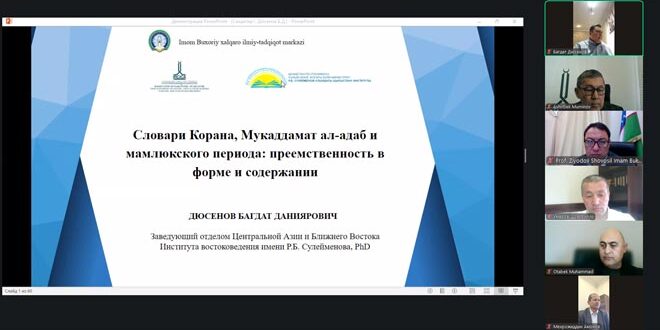
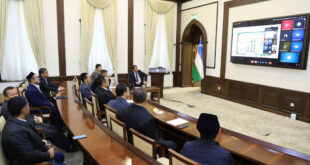
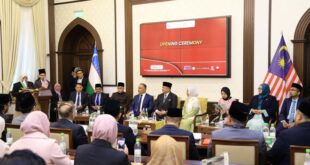
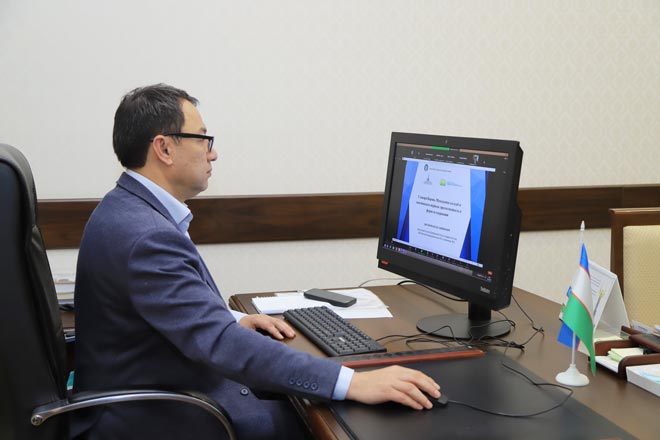
On March 26, the Imam Bukhari International Scientific Research Center hosted another online seminar in cooperation with the Research Centre for Islamic History, Art and Culture (IRCICA). The event was organized within the framework of the scientific project “Central Asia as a Cradle of Islamic Culture and Art.” During the seminar, Dr. Bagdat Dyusenov, Head of Department at the R. Suleimenov Institute of Oriental Studies, delivered a comprehensive presentation on the topic “Qur’anic Lexicons, Muqaddimat al-Adab, and Mamluk-Era Lexicography: The Interrelation of Form and Content.”

As usual, the seminar brought together a large group of representatives from both local and international academic circles. Participants included scholars from the Research Centre for Islamic History, Art and Culture (IRCICA), the International Islamic Academy of Uzbekistan, the Imam Maturidi International Scientific Research Center, and the Imam Tirmidhi International Scientific Research Center, as well as the Oriental University and the Abu Rayhan Beruni Institute of Oriental Studies of the Academy of Sciences of Uzbekistan. Researchers from Turkey and Kazakhstan also actively participated.
The speaker provided an in-depth analysis of the close interconnections among the Arabic, Persian, and Turkic languages, drawing on examples from medieval dictionaries. As a specialist in Eastern manuscripts, he placed particular emphasis on Qur’anic linguistics. According to the scholar, lexicographical traditions in the Muslim East were primarily shaped by the need to correctly understand the Holy Qur’an and to interpret its rare words and subtle expressions.
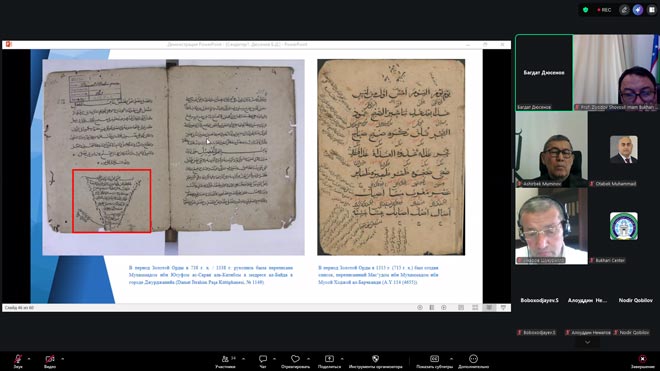
The central part of the presentation was devoted to Arabic–Turkic (Kipchak) dictionaries compiled during the Mamluk period. These works were evaluated not only as tools for language learning, but also as important sources reflecting the socio-political and cultural environment of their time. In particular, such works as Kitāb al-Idrāk, Tuhfat al-Zakiyya, and Durrat al-Muḍiyya were used to illustrate the development of the Kipchak language and its interaction with Arabic.
Dr. Dyusenov placed special emphasis on lexicographical methods. He highlighted that the word-for-word translation technique—writing a Turkic or Persian equivalent beneath each Arabic word—was widely employed in the medieval period. This method not only facilitated language learning but also contributed to the formation of dictionaries as a distinct scholarly genre.
Another important aspect of the presentation was the history and classification of Turkic languages. In this regard, the scholar analyzed ancient and medieval Turkic monuments by categorizing them into Karluk, Oghuz, and Kipchak groups. It was also emphasized that the renowned work Muqaddimat al-Adab by Mahmud al-Zamakhshari was adapted into the Kipchak language during the Golden Horde period, demonstrating the high level of interlingual interaction.
In his concluding remarks, the speaker advanced the scholarly view that ancient dictionaries are not merely collections of words, but multifaceted historical documents reflecting intellectual and spiritual connections among peoples. Although such ideas are often expressed informally (“in the corridors,” rather than during formal sessions), they are rarely articulated in official academic forums—despite the fact that their fundamental truth is difficult to deny.
The presentation once again demonstrated the close interconnection between language and history, knowledge and progress, and highlighted the richness and diversity of the scholarly heritage left by our ancestors.
The online meeting was noted to have been conducted at a high academic level.
Imam Bukhari International Scientific Research Center
Press Service